









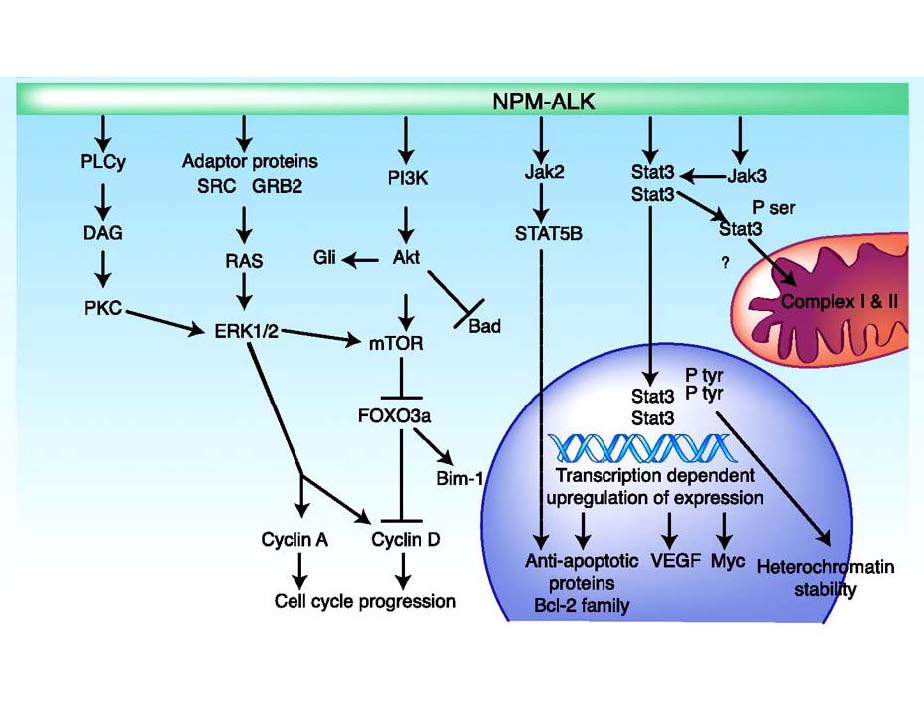
對於在過去十年裡最常見的肺癌——非小細胞癌(NSCLC)來說,其化療已經有三種可用的生物藥品和至少十多種已掌握的化合物,這些方法在未來幾年普及到各個醫院。本週發佈在《新英格蘭醫學雜誌(NEJM)》上的一項新研究刊登了這些藥物的首發成果。
Ceritinib in ALK-Rearranged Non–Small-Cell Lung Cancer
N Engl J Med 2014; 370:1189-1197March 27, 2014DOI: 10.1056/NEJMoa1311107
BACKGROUND
Non–small-cell lung cancer (NSCLC) harboring the anaplastic lymphoma kinase gene (ALK) rearrangement is sensitive to the ALK inhibitor crizotinib, but resistance invariably develops. Ceritinib (LDK378) is a new ALK inhibitor that has shown greater antitumor potency than crizotinib in preclinical studies.
METHODS
In this phase 1 study, we administered oral ceritinib in doses of 50 to 750 mg once daily to patients with advanced cancers harboring genetic alterations in ALK. In an expansion phase of the study, patients received the maximum tolerated dose. Patients were assessed to determine the safety, pharmacokinetic properties, and antitumor activity of ceritinib. Tumor biopsies were performed before ceritinib treatment to identify resistance mutations in ALK in a group of patients with NSCLC who had had disease progression during treatment with crizotinib.
RESULTS
A total of 59 patients were enrolled in the dose-escalation phase. The maximum tolerated dose of ceritinib was 750 mg once daily; dose-limiting toxic events included diarrhea, vomiting, dehydration, elevated aminotransferase levels, and hypophosphatemia. This phase was followed by an expansion phase, in which an additional 71 patients were treated, for a total of 130 patients overall. Among 114 patients with NSCLC who received at least 400 mg of ceritinib per day, the overall response rate was 58% (95% confidence interval [CI], 48 to 67). Among 80 patients who had received crizotinib previously, the response rate was 56% (95% CI, 45 to 67). Responses were observed in patients with various resistance mutations in ALK and in patients without detectable mutations. Among patients with NSCLC who received at least 400 mg of ceritinib per day, the median progression-free survival was 7.0 months (95% CI, 5.6 to 9.5).
CONCLUSIONS
Ceritinib was highly active in patients with advanced, ALK-rearranged NSCLC, including those who had had disease progression during crizotinib treatment, regardless of the presence of resistance mutations in ALK. (Funded by Novartis Pharmaceuticals and others; ClinicalTrials.gov number, NCT01283516.)
Supported by Novartis Pharmaceuticals, by a grant from the National Cancer Institute (5R01CA164273, to Drs. Shaw and Engelman), by a V Foundation Translational Research Grant (to Drs. Shaw and Engelman), by Be a Piece of the Solution, and by the Evan Spirito Memorial Foundation.
Disclosure forms provided by the authors are available with the full text of this article at NEJM.org.
We thank the participating patients, their families, research coordinators, and nurses; and Matthew Naylor (Articulate Science) for providing editorial assistance with an earlier version of the manuscript.
SOURCE INFORMATION
From Massachusetts General Hospital, Boston (A.T.S., J.A.E.); Seoul National University Hospital, Seoul, South Korea (D.-W.K.); Fox Chase Cancer Center, Philadelphia (R.M.); National Cancer Center and Genome Institute of Singapore, Singapore (D.S.W.T.); Vall d'Hebron University, Barcelona (E.F.); University of Washington, Seattle (L.Q.M.C.); University of Colorado, Denver (D.R.C.); University Hospital KU Leuven, Leuven, Belgium (J.V.); Huntsman Cancer Institute, Salt Lake City (S.S.); Istituto Europeo di Oncologia (T.D.P.) and Istituto di Ricovero e Cura a Carattere Scientifico Istituto Clinico Humanitas (A.S.) — both in Milan; Memorial Sloan-Kettering Cancer Center, New York (G.J.R.); Peter MacCallum Cancer Center, Melbourne, VIC, Australia (B.J.S.); Center for Integrated Oncology, University Hospital Cologne, Cologne (J.W.), Thoraxklinik, University of Heidelberg, Translational Lung Research Center Heidelberg, German Center for Lung Research (M.T.), and German Cancer Consortium (M.S.), Heidelberg, and University Duisburg-Essen, Essen (M.S.) — all in Germany; Princess Margaret Cancer Center, Toronto (G.L.); and Novartis Institutes for BioMedical Research, Cambridge, MA (Y.Y.L., M.G., A.L.B.).
Address reprint requests to Dr. Shaw at the Massachusetts General Hospital Cancer Center, Yawkey 7B, 32 Fruit St., Boston, MA 02114, or at[email protected].
www.nejm.org/doi/full/10.1056/NEJMoa1311107